Optima. Double Award Winner 2026!
Eason Digital Innovation Award | Technology Innovation Project of the Year

Solution
Maintenance
Industry
Aviation
Location
Global
Overview
Have you ever wondered…
How do airlines stay operational in an industry where downtime and inefficiency are measured in millions? The answer lies in strategic foresight, and that’s exactly where Optima comes in.
In the complex world of aviation, engine maintenance isn’t just a routine task, it’s one of the most financially and operationally critical activities an airline faces. Developed in partnership with PA Consulting and TGIS Aviation, Optima is a strategic solution that helps major airlines navigate the operational, regulatory, and contractual complexities of managing mixed fleets over the long term. Among our clients are top-tier global airlines recognized as leaders in the industry.
Challenges
Why Engine Maintenance is Such a Complex and Strategic Challenge?
Managing aircraft engine maintenance goes far beyond scheduling shop visits, it’s a complex puzzle involving engineering demands, legal obligations, and financial risk.
At the structural level, engines consist of life-limited parts, each with its own lifespan and replacement cycle. Planning around these limits requires not only deep technical expertise but also long-term foresight. On top of that, many aircraft are leased, and lease agreements are filled with detailed return conditions and component life requirements, each tailored to the specific asset. Maintenance planning must be tightly aligned with these terms to minimize lease compensation fees and avoid unnecessary financial exposure.
Engine maintenance is not just a technical necessity, it’s a multi-million-dollar strategic concern. Each engine may undergo 2 to 5 shop visits during its lifecycle, with each visit lasting 3 to 9 months and costing up to $12 million. Not only, airlines must also manage several operational challenges:
- Dynamic fleet plans, with aircraft entering and leaving service at different times, often combined with high uncertainty around the delivery dates of new aircraft;
- Mixed fleet ownership, including both owned and leased aircraft, where leased aircraft come with strict return conditions and contractual requirements;
- Regulatory compliance, which must be continuously updated to reflect evolving rules and new airworthiness directives;
- Unexpected events, such as bird strikes or emergency bulletins.
It’s a high-complexity environment with countless interdependent variables. Most airlines have historically relied on reactive, short-term, engine-by-engine planning. This approach overlooked a major opportunity: planning the entire engine pool as one interconnected system.
Solution
Enter Optima: Plan Aircraft Maintenance Smarter, Not Harder
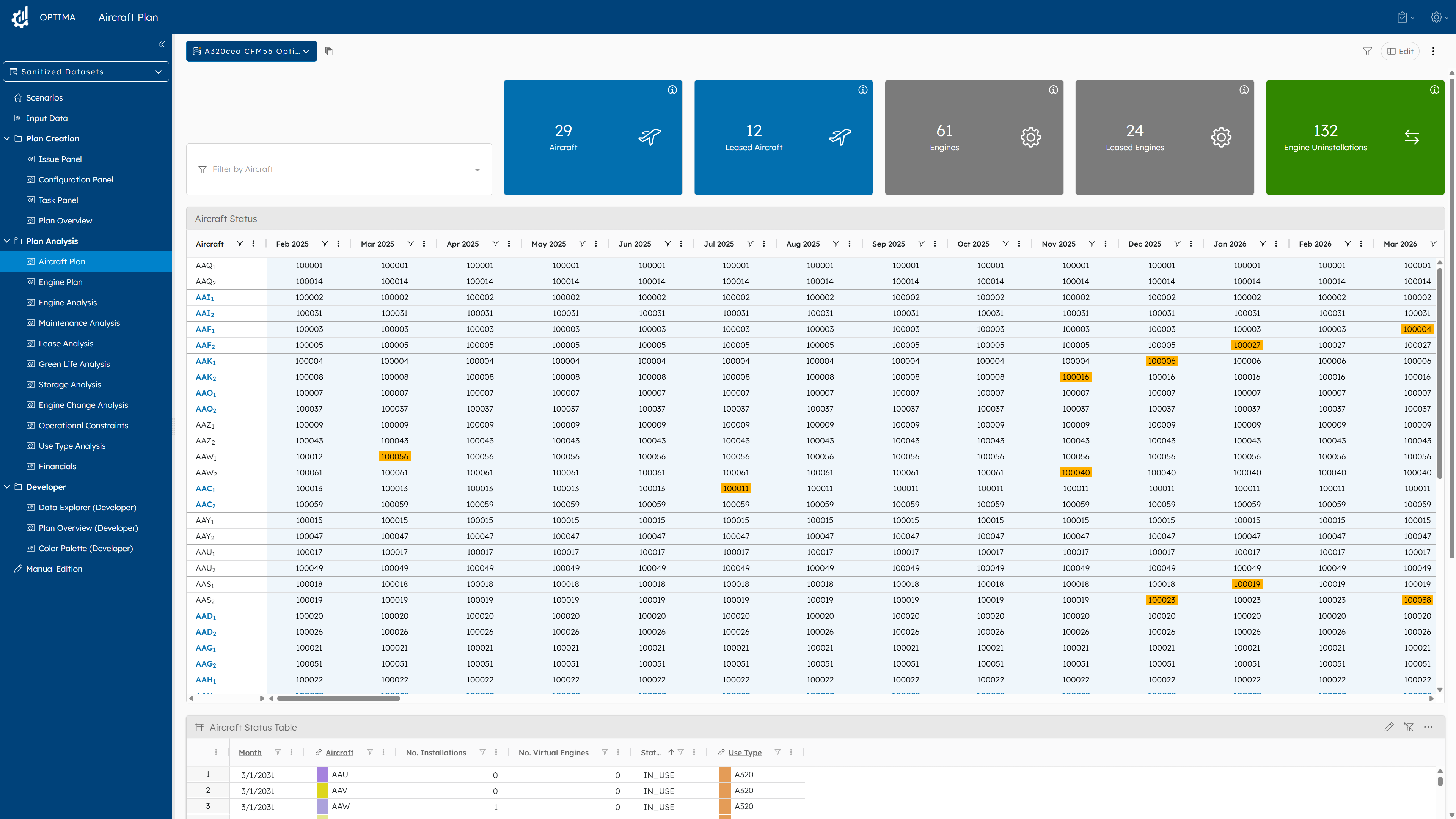
Optima was designed to shift aircraft maintenance planning from tactical and fragmented to strategic, optimized, and long-term, with a 20-year horizon in mind.
What Makes Optima Different?
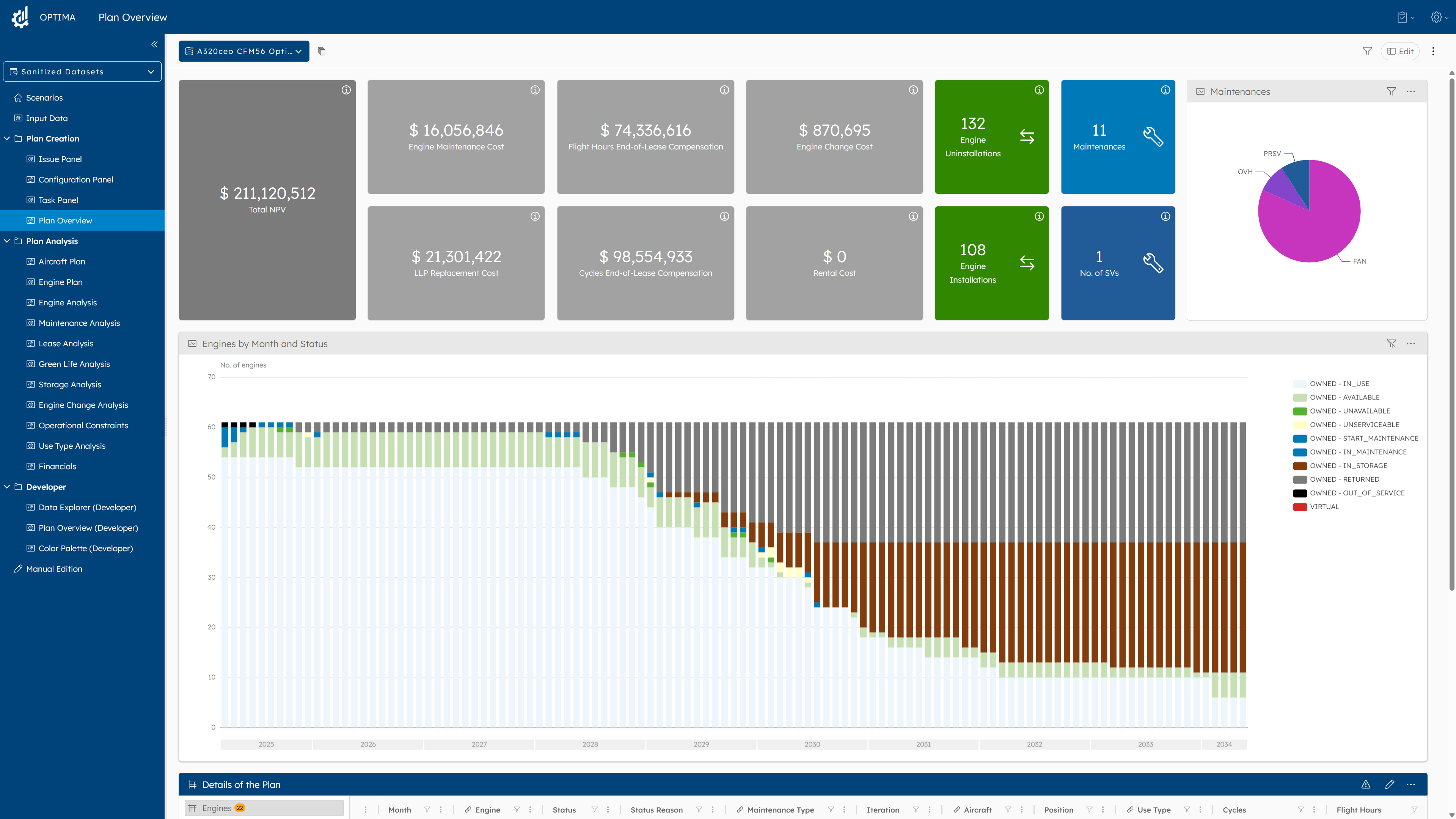
- Advanced mathematical optimization: Optima uses Mixed Integer Programming (MIP) to generate maintenance plans that are not only compatible but cost-effective and adaptable to change;
- Cloud-based parallel processing: capable of handling complex and large-scale scenarios with speed and accuracy;
- Customizable and scalable: adaptable to each airline’s unique needs and operational realities and scales effortlessly with business growth;
- Expert-driven evolution: backed by domain experts, Optima evolves constantly through client feedback and regulatory changes, ensuring it stays ahead of industry needs;
- Broad engine and fleet compatibility: designed to support a wide variety of engine types and fleet configurations, whether working with legacy engine technologies or new modular architectures, narrow-body or wide-body aircraft, and fleets ranging from 20 to over 300 aircraft.
The Impact: What Airlines Gain with Optima
Optima is already delivering results where it matters most.
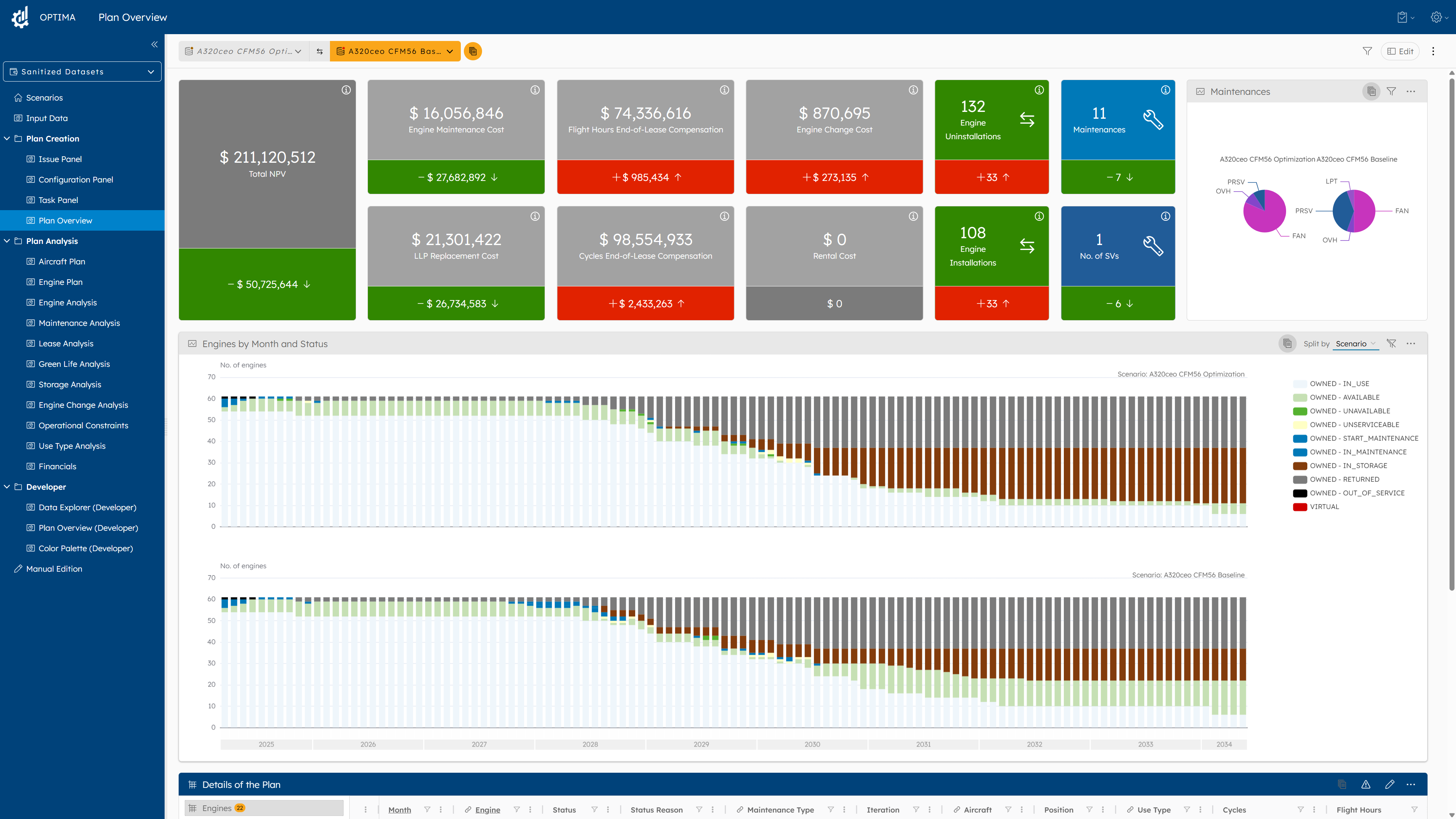
- 10 to 20% reduction in maintenance cost and lease compensation: avoiding unnecessary inspections and optimizing part lifecycles – saving $1 to $2 million per aircraft;
- Lease compliance made easier: ensuring engines meet end-of-lease conditions and guiding cost-effective compensation decisions;
- Better fleet availability: preventing aircraft groundings by identifying and mitigating maintenance bunching (overlap shop visits);
- Optimized spare engine inventory: maintaining the right Line of Balance (LOB), by ensuring enough spare engines to handle disruptions, reducing delays and cancellations;
- Tailored fleet planning strategies: reducing costs for older aircraft, preserving value for newer ones, and improving entry and retirement planning by identifying aging aircrafts and upcoming deliveries;
- Scenario-based planning: allowing airlines to create and compare multiple maintenance strategies and choose the best-performing option based on data-driven decisions.
Results
Results That Take Off
While aviation engine planning sounds niche, the principle is universal: proactive planning beats reactive firefighting. Optima turns complexity into clarity, risk into readiness – with results already being felt:
- Airlines are saving up to 20% on engine maintenance and lease compensation costs;
- Optima’s capabilities continue to grow, attracting growing interest from airlines smarter, more strategic planning.
As aviation faces pressures, with rising costs, tighter regulations, and supply chain shocks, Optima is more than a planning tool. It’s a strategic advantage.
Smart Planning Takes You Further
Optima is redefining how the aviation industry manages engine maintenance and leases redeliveries. It brings together deep expertise, cutting-edge optimization, and real-world adaptability, proving that smarter planning truly pays off, in every sense.
Want to learn more? Discover how our maintenance planning and scheduling optimization solutions can help your business thrive.
Optima FAQs
Optima is a strategic engine maintenance planning tool that uses advanced optimization and aviation expertise to navigate the operational, regulatory, and contractual complexities of managing fleets over the long-term. It creates fleet-wide plans that avoid unnecessary shop visits, align with lease terms, and improve spare engine usage, helping airlines save up to 20% on maintenance and lease compensation costs.
Because of the engineering complexity of aircraft engines, regulatory compliance, lease contract terms, unpredictable events, and long planning horizons, all of which must be coordinated across a dynamic fleet over several years.
Reactive short-term planning can lead to overlapping shop visits, aircraft groundings, higher lease compensation fees, and inefficient use of spare engines, driving up costs and reducing fleet availability.
Optima incorporates lease return terms directly into its planning data model, ensuring compliance while avoiding unnecessary part replacements. This reduces redelivery costs and helps airlines make smarter end-of-lease decisions.
Yes. Optima is built for mixed fleets, adapting its strategies to different engine types, ownership structures, and contractual obligations, all within a unified, scalable planning model.
By integrating engineering, leasing, and financial perspectives into a single optimized plan, Optima provides a holistic view about fleet management For example, it aligns engine life cycles and component replacement schedules with lease return conditions, showing whether extending the lease is more cost-effective or if returning the aircraft avoids costly end-of-lease maintenance. It also allows airlines to compare scenarios, for instance, keeping older aircraft despite higher maintenance costs versus bringing new aircraft into service sooner. This scenario-based planning helps airlines balance capital investments, fleet availability, and contractual compliance, ensuring long-term financial and operational predictability.
When dealing with assets that are new and not yet fully understood, the key challenge is uncertainty. Optima helps airlines manage this by modeling multiple scenarios and alternative plans. For example, it can simulate how an engine’s lifespan changes depending on whether it operates mainly on short-haul or long-haul routes. It also allows airlines to test “what-if” situations, such as discovering that a part expected to last 10 years actually fails much earlier, and then adjust strategies accordingly. By comparing these scenarios, airlines can anticipate risks, optimize spare engine usage, and make maintenance plans more resilient and proactive.
Other Customer Stories