
Solution
R&D Support
Industry
Pulp & Paper Manufacturing
Location
Europe
Overview
How a global industrial organization strengthened operational resilience and boosted maintenance team efficiency up to 40% by combining AI-driven advanced optimization with human expertise.
A leading global industrial developer and supplier of process technologies for the pulp, paper, and energy sectors, delivers maintenance services across multiple plants worldwide. As operations grew in scale and complexity, the organization faced growing challenges in maintaining reliable, executable maintenance schedules across sites, challenges that increasingly impacted production efficiency and teams productivity.
Maintenance planning relied heavily on manual processes, particularly for building and maintaining work schedules. Scheduling cycles were long and error-prone, practices varied from plant to plant, and even small changes in priorities or resource availability required substantial manual rework.
Data inconsistencies, limited real-time visibility, and fragmented communication made execution fragile. Plans quickly became outdated as conditions changed, reducing the organization’s ability to respond effectively to disruptions such as unplanned work, shifting production constraints, or workforce availability issues. What initially appeared as a work scheduling efficiency problem had evolved into a broader operational resilience and reliability challenge, directly affecting maintenance execution quality, production continuity and reduction of operational costs.
The organization needed a solution that could standardize, automate, and optimize maintenance work scheduling, while preserving the flexibility planners need to manage real-world constraints and last-minute changes.
Challenges
From Manual Planning to AI-driven Intelligent Optimization
We designed and implemented a cloud-based maintenance optimization solution capable of transforming maintenance planning from a manual, fragmented activity into a standardized, intelligent, and scalable process:
- Automating workforce sizing and task assignment;
- Optimally scheduling maintenance operations across teams and technicians;
- Shorter shutdown periods, the maintenance plan takes into account isolation and de-isolation of machines, maximizing production uptime;
- Handling complex constraints related to deadlines, priorities, skills, tools, shifts, and production activity;
- Enabling fast re-scheduling in response to operational change;
- Seamlessly integrating with existing maintenance execution systems;
- Preserving planners’ expert knowledge while increasing standardization globally.
Solution
Automating SAP Maintenance Workflows for Real-Time Planning Optimization
The solution introduced a dedicated optimization layer integrated into the client’s existing internal maintenance environment. Prior to this, planners built schedules manually using spreadsheets and Gantt-based tools, relying heavily on personal expertise to balance constraints, resolve conflicts, and adjust plans when conditions changed.
The new optimization engine augments, rather than replaces, these planning practices.
It automatically retrieves master data such as resources, equipment, and work orders from the client’s existing maintenance application (integrated with SAP). It then generates an optimized maintenance plan and feeds it back into the same environment used for execution, providing near real-time updates as work progresses.
At its core, the system uses a hybrid optimization approach, combining:
- Constraint Programming, to rigorously respect hard and soft operational constraints;
- Heuristic methods, to improve flexibility, robustness, and performance in real-world scenarios.
This combination enables the engine to efficiently manage highly complex schedules.

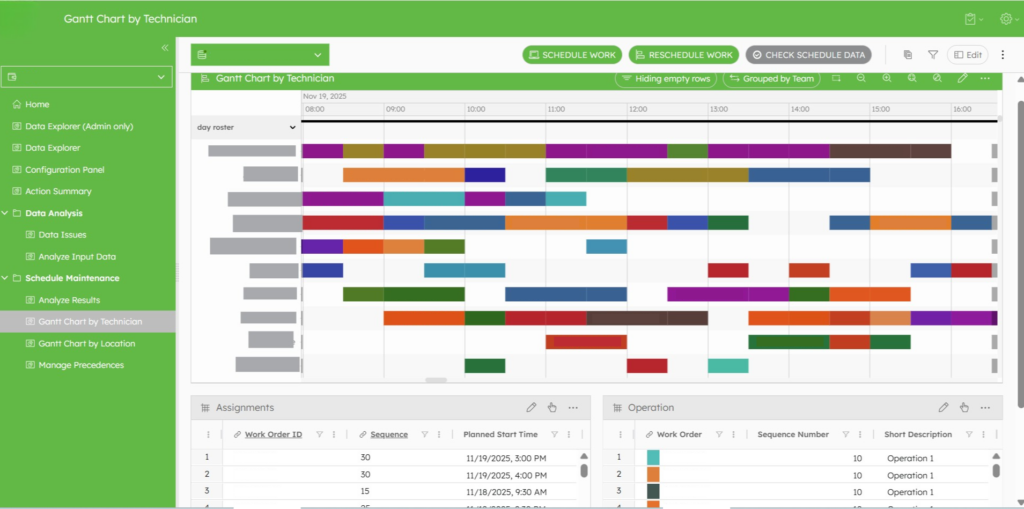
Schedule per Technician
A Key Differentiator: Decision Freezing
Most traditional optimization systems present planners with a binary choice: either fully accept the algorithm’s schedule or reject it and revert to manual planning. This “all-or-nothing” approach is precisely why many optimization tools struggle with real adoption.
This solution takes a fundamentally different approach.
Planners can explicitly freeze key decisions, such as assigning a specific technician to a task at a given time, or grouping preferred technicians together, directly within an intuitive interface.
These frozen decisions reflect critical knowledge that rarely exists in formal systems: experience with specific equipment, team dynamics, or contextual nuances that algorithms alone cannot infer. The optimization engine fully respects human input, recalculating the rest of the schedule while fully respecting planner decisions, ensuring the final plan is both mathematically optimal and operationally realistic.
Result Analytics Dashboard
This hybrid model enables:
- Faster adoption of digital planning tools;
- Increased trust in automated schedules;
- A smooth transition from manual planning to intelligent optimized planning.
The Technical Stack: Scaling Maintenance Optimization with DB Gene and IBM ILOG
The solution is powered by a robust and scalable technology stack, designed to support complex optimization models while meeting demanding performance requirements.
- High-performance cloud optimization platform (IBM Decision Optimization Center);
- IBM ILOG CP Optimizer;
- Hybrid Constraint Programming and Heuristic models.
Results
The Strategic Value of Hybrid Intelligence in Industrial Maintenance
Initial performance indicators highlight the solution’s ability to significantly improve planning speed, accuracy, and visibility.
- Maintenance schedules generated in ~10 minutes for annual, monthly, and weekly shutdowns compared to several hours;
- Re-scheduling completed in 2–5 minutes, dramatically reducing planner’s effort;
- Significant reduction in manual data handling through automated integration;
- Boosted maintenance team efficiency by up to 40% through intelligent workforce scheduling;
- Optimized resource allocation, maximizing internal workforce utilization and reducing reliance on subcontractors.
Why It Matters
Traditional optimization treats human input as a limitation to manage. This solution treats it as intelligence to work with.
By combining advanced optimization algorithms with planner expertise, the organization now generates executable maintenance work schedules in minutes instead of days, and adapts to change in minutes instead of hours. The result is not only faster planning, but better decisions, improved resource utilization, and a more resilient maintenance operation.
This project demonstrates how hybrid intelligence, where humans and algorithms work together, can deliver sustainable operational value far beyond automation alone.
Other Customer Stories