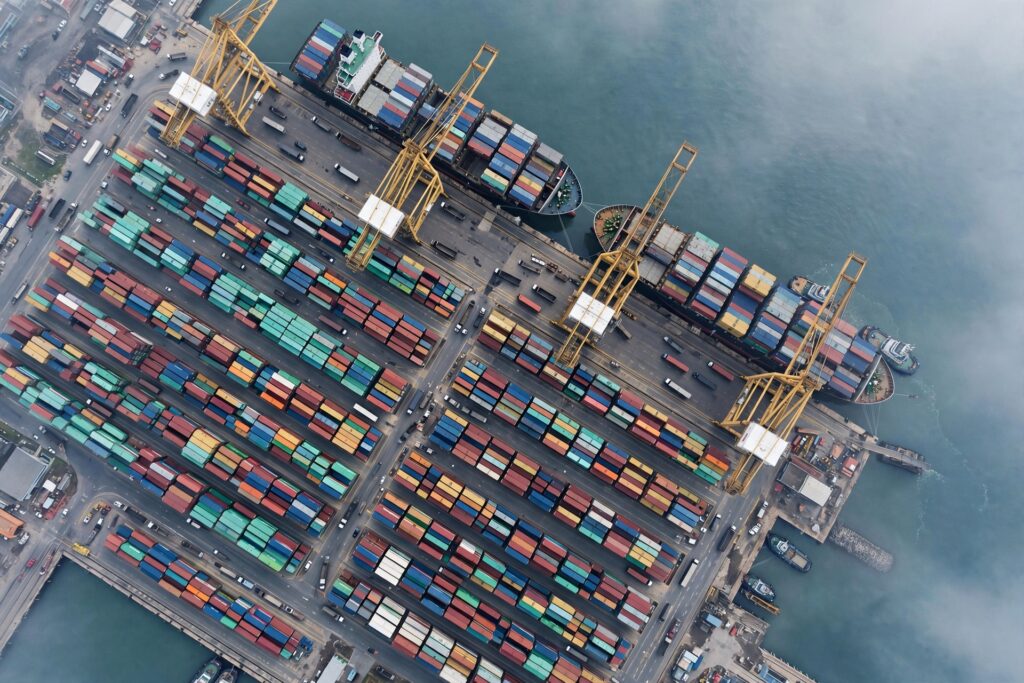
The manufacturing industry is responsible for transforming raw materials into the finished goods we use every day. While it has long been a foundation of industrial progress, the industry is now undergoing a radical digital transformation.
Manufacturing & Production Industry: From Industrial Revolutions to Industry 4.0
As a key driver of global trade and innovation, manufacturing combines engineering, production processes, and supply chain management to enable the efficient creation of goods at scale.
Today, however, this transformation is accelerating, driven by digital technologies, automation, and advanced analytics. To understand where the industry is heading, it is essential to explore both how manufacturing systems operate and how they have evolved over time.
Check out our NEW Manufacturing Optimization Cheat Sheet!
The Evolution of Manufacturing: From Industry 1.0 to Industry 4.0
The concept of Industry 4.0 emerged in Germany in 2011 during the Hannover Messe Fair, as part of a national initiative focused on advanced manufacturing and digitalization. Since then, it has become the global reference for smart, connected industrial operations.
While Industry 1.0 through 3.0 introduced mechanization, electricity, and automation, Industry 4.0 represents a fundamental shift, from isolated automation to intelligent, connected systems.
- Industry 1.0 introduced mechanization through water and steam power in the late 18th century.
- Industry 2.0 brought electricity and enabled mass production, with assembly lines and division of labor.
- Industry 3.0 introduced electronics, IT systems, and automation starting in the 1970s.
- Industry 4.0, the current phase, integrates digital technologies to create interconnected, intelligent production systems.
The term Industry 4.0 has seen significant growth in interest, especially in 2026, reflecting the increasing digitalization of manufacturing systems.
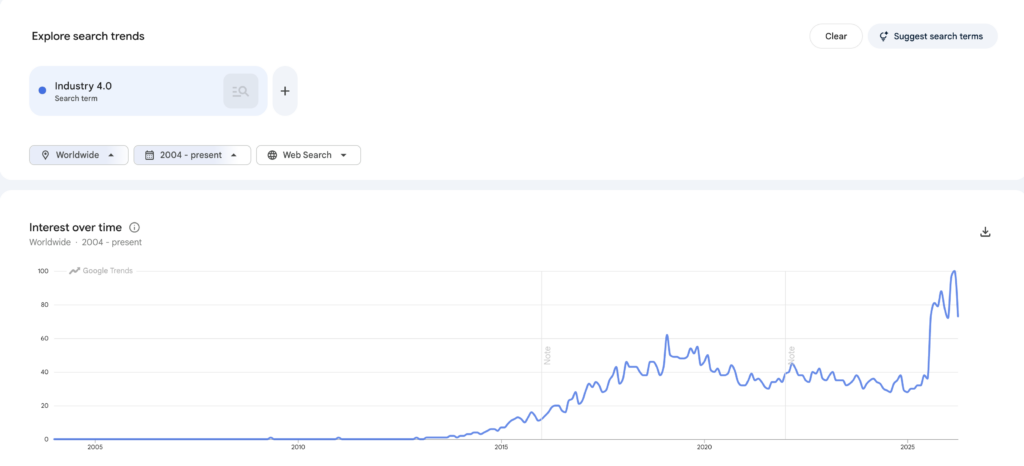
Google Trends, April 2026
This growing interest highlights how manufacturers are actively investing in digital transformation and smart factory initiatives. Unlike previous industrial revolutions, Industry 4.0 is defined by the fusion of physical and digital systems, placing data at the center of operations through:
- IoT & Cloud Computing: Allows real-time data exchange across the entire factory floor.
- Digital Twins: Creates virtual replicas of physical systems, allowing simulation and optimization before implementation.
- Artificial Intelligence (AI): Enables predictive insights and autonomous, data-driven decision-making in real time.
Rather than simply improving efficiency, Industry 4.0 represents a fundamental shift in how value is created, moving manufacturing toward data-driven, interconnected, and adaptive systems.
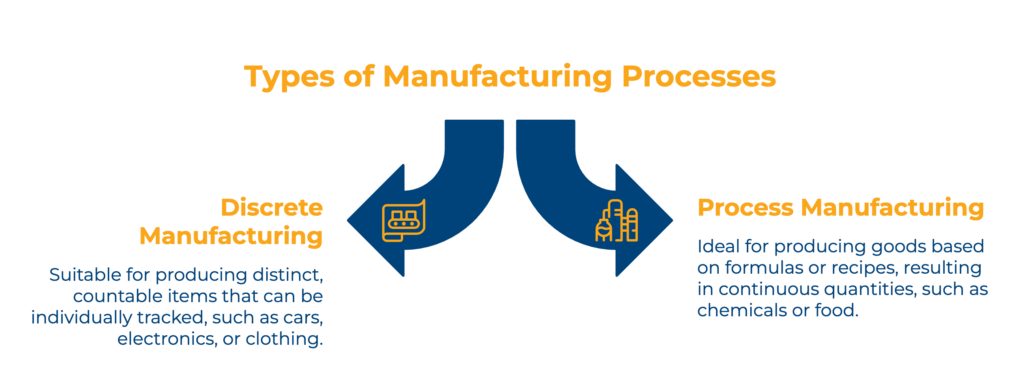
Check out our Glossary of Manufacturing Operations to explore key terms, concepts, and definitions that will help you better understand how modern manufacturing systems work.
Challenges in the Manufacturing Industry
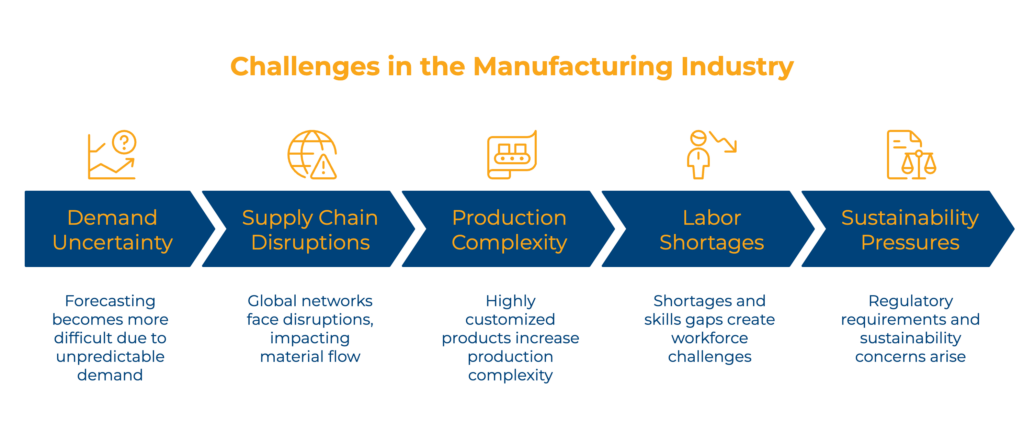
Modern manufacturing operates in an increasingly complex and volatile environment. Companies must deal with unpredictable demand, global supply chain disruptions, and growing pressure for customization and sustainability.
These challenges are not isolated, they are interconnected and require more advanced, data-driven approaches to manage effectively.
See how DecisionBrain helped Cooperl optimize production planning in a complex operating environment.
Technology Transforming Manufacturing
The rise of Industry 4.0 technologies is transforming traditional manufacturing systems into intelligent ecosystems. Key technologies include:
- Manufacturing Execution Systems (MES) enable real-time monitoring and control of production processes.
- Advanced Planning Systems (APS) use optimization algorithms to improve planning and scheduling decisions, as seen in DecisionBrain’s paint line optimization project for auto parts manufacturing.
- Digital Twins serve as a simulation layer, allowing manufacturers to stress-test production changes and identify potential failures in a virtual environment before they become costly physical mistakes.
- Automation and robotics increase consistency, speed, and safety.
- Artificial Intelligence (AI) enhances forecasting, predictive maintenance, and decision-making.
As these technologies become increasingly integrated, manufacturing systems evolve into what is known as smart manufacturing. In smart factories:
- Mass Customization: Factories can efficiently produce small batches of highly customized products.
- Decentralized Decision-Making: Production systems can make localized decisions without continuous human intervention.
- Increased Efficiency and Agility: Real-time data and optimization algorithms lead to minimal downtime and faster response to market changes.
- Predictive Maintenance: AI analyzes machine data to predict failures before they occur, maximizing equipment uptime.
This represents a shift from reactive to proactive manufacturing, where decisions are increasingly driven by data rather than intuition.
Key Takeaways for the Manufacturing Industry
The manufacturing industry is evolving rapidly as digital technologies reshape traditional production models. From production planning and scheduling to real-time execution and supply chain integration, Industry 4.0 is transforming how manufacturing systems operate.
Organizations that embrace data-driven decision-making, automation, and interconnected systems will be better positioned to improve efficiency, reduce costs, and remain competitive in a complex global market.
Manufacturing & Production Industry: From Industrial Revolutions to Industry 4.0
Read our blog post on Mnaufaturing Optimization in the age of AI.
Manufacturing Optimization Solutions Cheat Sheet (PDF)
We’ve consolidated everything you need to know about Manufacturing Optimization.
DecisionBrain is a leading provider of advanced decision support software that is used to solve the world’s hardest supply chain, workforce and maintenance planning, scheduling & logistics optimization problems. With over 400 person-years of experience in machine learning, operations research and mathematical optimization, DecisionBrain delivers custom-fit decision support systems where packaged applications fall short. Read more about us or contact us to talk about our solutions!
Read also