Blog
The Cold Chain Race: How Prescriptive Optimization Solves the Perishable Routing Problem for Meat Processors
Production is finished. The products are packaged, labeled, and ready to leave the facility. At this point, many people assume the hardest part is over.
In reality, an entirely new planning problem has just begun.
Unlike many manufacturing industries, fresh meat loses value every hour it spends waiting. A production delay, a truck leaving later than planned, or inventory sitting too long in a chilled warehouse doesn’t just affect delivery schedules, it directly impacts shelf life, customer acceptance, profitability, and waste.
For companies supplying supermarkets through daily or multiple weekly deliveries, distribution planning has become far more than a logistics exercise. It has become a continuous optimization problem requiring hundreds of interconnected decisions before time runs out.
This is why many meat processors are replacing manual planning with distribution planning software capable of simultaneously optimizing inventory allocation, shelf-life preservation, delivery scheduling, transportation resources, and customer service requirements.
Shelf Life Doesn’t End at Production
Distribution Planning Systems for Meat Processors: Managing Shelf Life and High-Frequency Retail Deliveries
Production planning determines what gets produced and when. Distribution planning determines whether that value is preserved.
Fresh meat is one of the few products whose commercial value begins to decline almost immediately after production. Every additional hour spent waiting for allocation, loading, transportation, or delivery reduces the remaining shelf life available to retailers. As noted by the American Meat Science Association (AMSA), shelf life and product quality begin to decline as soon as fresh meat is fabricated and packaged, making time a critical factor throughout the supply chain.
That creates a very different planning environment.
Unlike shelf-stable products that can remain in inventory for weeks, fresh meat constantly moves against the clock. Every decision must consider not only where products need to go, but also how much usable shelf life will remain when they arrive.
According to a study published in the MDPI journal Sustainability, an estimated 23% of all production in the meat sector is lost or wasted. While consumers generate the largest portion of this waste, distribution logistics and manufacturing account for a combined 32% of total supply chain losses. In highly compressed retail environments, much of this waste is driven directly by systemic failures in cold-chain scheduling, leading to early expiration before the product ever reaches a grocery shelf.
The challenge becomes even greater when serving multiple retail distribution centers. Each customer has different delivery windows, replenishment schedules, and freshness requirements. Some retailers require products to arrive with a minimum remaining shelf life, while others impose strict receiving windows or inventory rotation policies. As a result, planners must continuously balance customer requirements with inventory availability, transportation capacity, warehouse operations, and production timing.
| Logistics Variable | Standard Case Goods | Fresh Meat Products |
| Primary Constraint | Transport Cost & Volume | Expiration Clock & Temperature |
| Inventory Strategy | First-In, First-Out (FIFO) | First-Expired, First-Out (FEFO) |
| Retail Penetration | Weekly/Bi-weekly | Daily / High-Frequency |
| Rejection Risk | Damaged packaging | Microscopic shelf-life thresholds |
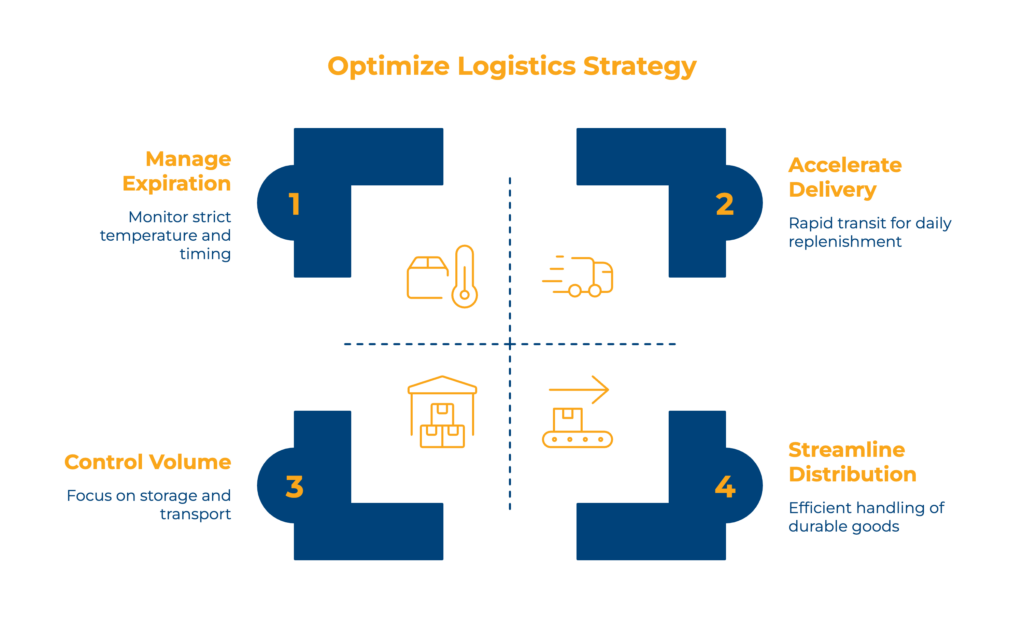
Navigating Strict Retailer Mandates and Dynamic Decay
Imagine it’s 8:00 a.m. Today’s production has been completed. Five retail distribution centers are waiting for deliveries.
Some products were packaged this morning. Others were produced yesterday. Several orders could be consolidated into a single truck, while others require immediate shipment to preserve freshness.
Now the planner needs to answer questions like:
- Which distribution center should receive today’s freshest inventory?
- Which product batches should be allocated to each customer?
- Should this truck leave immediately or wait for additional orders?
- Can these deliveries still satisfy every retailer’s shelf-life requirements?
- Should excess inventory remain fresh or be redirected to frozen storage?
Each decision appears manageable on its own.
To understand the operational gravity of these questions, consider a real-world scenario: A major grocery chain enforces a strict 75% Remaining Shelf Life (RSL) mandate at their receiving dock. If a vacuum-sealed pork loin has a total shelf life of 12 days, it must arrive at the retailer’s DC with at least 9 days remaining.
If a manual scheduling delay causes the shipment to arrive with only 8 days of remaining shelf life, the retailer’s automated receiving system will trigger a total load rejection. The processor is then forced to either liquidate the batch to a discount channel at a steep loss or write it off entirely—a catastrophic cost that standard logistics software fails to prevent.
Each of these daily allocation decisions appears manageable on its own. The challenge is that none of them exists independently.
Waiting another hour may improve truck utilization but reduce delivered freshness. Shipping immediately preserves shelf life but increases transportation costs. In meat processing, transportation is already a major operational expense because products must be moved in refrigerated trucks. Dispatching those trucks before they are fully utilized may preserve freshness, but it also drives distribution costs even higher. Allocating today’s freshest batches to one retailer automatically changes the inventory available for everyone else.
This is why distribution planning is far more than transportation or route optimization. Before a truck even leaves the warehouse, planners must coordinate inventory availability, remaining shelf life, customer priorities, delivery commitments, warehouse capacity, production schedules, and transportation resources.
The objective isn’t simply to deliver products. It’s to deliver the right products, to the right retail distribution center, at the right time, while maximizing remaining shelf life and controlling operational costs.
As more customers, products, warehouses, and delivery schedules are added, the number of possible planning scenarios grows exponentially.
Transitioning from FIFO to Automated FEFO Optimization
Experienced planners understand the trade-offs involved in meat distribution. The challenge isn’t knowing what matters, it’s evaluating all the possible combinations quickly enough to make the best decision.
A delayed production run, a last-minute order, unexpected traffic, or a truck becoming unavailable can completely change the optimal distribution plan. Yet manual tools like spreadsheets can’t continuously evaluate hundreds of products, multiple retail distribution centers, customer-specific shelf-life requirements, delivery windows, transportation capacity, and inventory availability all at once.
Instead of optimizing the entire operation, planners are often forced to make one decision at a time based on experience and the information available at that moment.
Optimization changes that approach.
Rather than asking a single question, such as which truck should leave next, a distribution planning system evaluates thousands of feasible scenarios simultaneously. It determines which customers should receive the freshest inventory, which deliveries should be consolidated, which products should ship immediately, and which routes best balance freshness, transportation costs, and service levels, all while respecting operational constraints.
The result isn’t simply a better delivery schedule. It’s a smarter distribution plan that preserves shelf life, improves customer service, reduces waste, and helps processors make better decisions across the entire distribution network.
Maximizing Yield and Contract Compliance in Fresh Food Logistics
For meat processors, distribution planning is a critical step in preserving product value throughout the supply chain. Allocation decisions influence freshness. Delivery schedules impact customer satisfaction, while transportation plans affect waste, profitability, and service performance.
As retailers continue demanding more frequent deliveries, shorter lead times, and stricter freshness requirements, distribution planning becomes a critical competitive capability.
Companies that still rely on manual planning often struggle to balance all these variables simultaneously.
Those using optimization-driven distribution planning systems can evaluate thousands of possible scenarios before products ever leave the warehouse, helping ensure that every shipment preserves as much freshness, value, and profitability as possible.
Because in fresh food distribution, the race against the clock doesn’t end when production finishes.
That’s when it truly begins.
If shelf-life pressure and delivery complexity sound familiar, speak with one of our experts to explore what’s possible for your specific need.
References:
- Karwowska, M., Łaba, S., & Szczepański, K. (2021). Food loss and waste in meat sector—why the consumption stage generates the most losses? Sustainability, 13(11), 6227. https://www.mdpi.com/2071-1050/13/11/6227
- Rami, Y., & Allouhi, A. (2024). Design, economic, and environmental accounting assessment of a solar-powered cold room for fish storage in traditional markets. Sustainability, 16(7), 3080. https://www.mdpi.com/2071-1050/16/7/3080
- Salin, V. (2020). 2020 GCCA Global Cold Storage Capacity Report. Global Cold Chain Alliance. https://www.gcca.org/wp-content/uploads/2023/02/2020-GCCA-Global-Cold-Storage-Capacity-Report-FINAL-v2.pdf
- Seman, D. L., Boler, D. D., Carr, C. C., Dikeman, M. E., Owens, C. M., Keeton, J. T., Pringle, T. D., Sindelar, J. J., Woerner, D. R., de Mello, A. S., & Powell, T. H. (2018). Meat science lexicon. Meat and Muscle Biology, 2(2), 1-15. https://www.iastatedigitalpress.com/mmb/article/id/9036/
- Utama, D. M., Dewi, S. K., Wahid, A., & Santoso, I. (2020). The vehicle routing problem for perishable goods: A systematic review. Cogent Engineering, 7(1). https://www.tandfonline.com/doi/full/10.1080/23311916.2020.1816148
At DecisionBrain, we deliver AI-driven decision-support solutions that empower organizations to achieve operational excellence by enhancing efficiency and competitiveness. Whether you’re facing simple challenges or complex problems, our modular planning and scheduling optimization solutions for manufacturing, supply chain, logistics, workforce, and maintenance are designed to meet your specific needs. Backed by over 400 person-years of expertise in machine learning, operations research, and mathematical optimization, we deliver tailored decision support systems where standard packaged applications fall short. Contact us to discover how we can support your business!
Read also