Blog
Can Standard Workforce Planning Tools Handle Operational Complexity?
Workforce planning has never been a simple equation. Fluctuating demand, complex labor rules, geographically distributed teams, and the constant pressure to do more with less, these are challenges that have pushed organizations to look beyond spreadsheets and generic HR software.
Standard tools are entering a market with real, pressing needs. But what does it actually take to optimize workforce planning at scale? More importantly, why do so many workforce initiatives fail to deliver meaningful operational improvements despite investing in advanced scheduling technology?
The Core Problem: Workforce Planning Is an Optimization Problem
When demand is predictable and teams are small, workforce planning can still be managed manually. But as operations grow more complex, with multiple locations, specialized skills, reactive tasks mixed with planned activities, and seasonal fluctuations, the planning challenge quickly becomes unmanageable manually.
The challenge is no longer just creating schedules. It is continuously balancing competing constraints, operational priorities, workforce availability, and unpredictable disruptions at scale.
This is where intelligent scheduling, forecasting, and optimization begin to create real operational value.
One of the most common misconceptions in workforce planning is treating forecasting, scheduling, and dispatching as separate operational problems. In reality, these decisions are deeply interconnected, and optimizing one layer in isolation often creates inefficiencies somewhere else in the operation.
Intelligent Scheduling Connects Planning Horizons
Intelligent scheduling is often associated with advanced algorithms and automation. However, in workforce-intensive operations, its real value lies in connecting decisions across different planning horizons while continuously adapting to changing conditions.
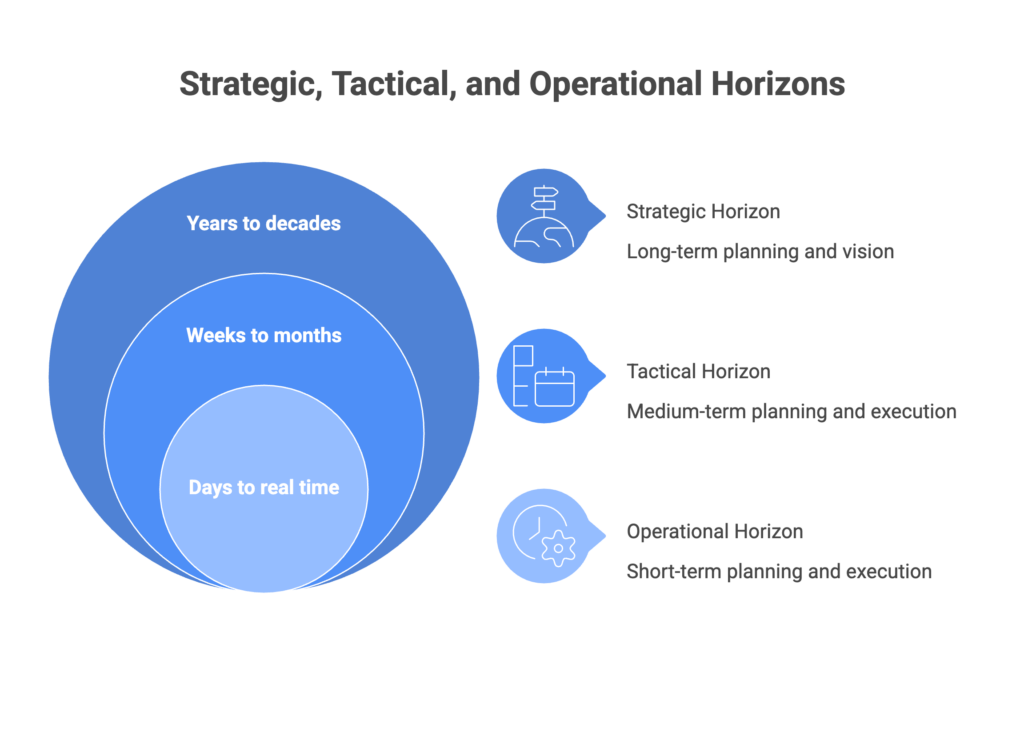
Effective workforce management is not a single scheduling exercise. Organizations make workforce decisions across three planning horizons, each requiring different forecasting and planning capabilities.
-
Strategic horizon (months to years)
At the strategic level, organizations make long-term decisions about workforce design, capacity planning, hiring plans, skill development, territory structures, and outsourcing strategies.
Forecasting at this horizon typically relies on historical trends, business growth assumptions, contractual commitments, and scenario analysis to estimate future workforce requirements. These forecasts support workforce design decisions, hiring plans, and long-term capacity planning.
-
Tactical horizon (weeks to months)
At the tactical level, organizations translate long-term workforce strategies into medium-term execution plans. This includes shift design, vacation planning, training schedules, temporary workforce allocation, and preparation for expected demand fluctuations.
Forecasts become more granular, combining historical patterns with seasonal effects, customer commitments, and planned projects. These forecasts help ensure workforce capacity is aligned with anticipated demand before operations begin.
-
Operational horizon (days to real time)
At the operational level, organizations focus on daily scheduling, dispatching, route optimization, and responding to changing conditions throughout the day.
Forecasting becomes significantly more dynamic. Employee absences, urgent service requests, weather conditions, traffic disruptions, equipment failures, and shifting priorities can quickly alter workload requirements.
This is where machine learning and real-time forecasting techniques can provide the greatest value, continuously updating workload expectations and helping dispatch systems adapt schedules as conditions change.
Intelligent workforce systems connect these three horizons, ensuring that long-term workforce plans, medium-term staffing decisions, and real-time operational execution remain aligned.
| Planning Horizon | Core Focus | Standard Workforce Tools | Intelligent Optimization Systems |
|
Strategic
(Months to Years) |
Workforce design, hiring plans, capacity planning, and long-term scaling. | Relies on basic historical averages; fails to account for complex “what-if” growth scenarios. | Uses advanced scenario analysis and predictive modeling to size the future workforce accurately. |
|
Tactical
(Weeks to Months) |
Shift design, vacation planning, and temporary resource allocation. | Manages schedules in isolation; struggles with multi-location constraints and seasonal spikes. | Connects scheduling with labor rules and seasonal forecasts to balance compliance and cost. |
|
Operational
(Days to Real-Time) |
Daily dispatching, routing, and handling last-minute disruptions. | Reaches its limits quickly when unexpected absences, weather, or urgent jobs require manual rescheduling. | Uses machine learning and real-time algorithms to instantly re-optimize routes and schedules automatically. |
Optimization and Real-Time Adaptability
Forecasting alone does not optimize workforce performance. Once demand is understood, organizations must determine how available resources should be allocated.
Optimization techniques such as constraint programming and mixed-integer programming help organizations evaluate large numbers of potential workforce plans and schedules while balancing workforce availability, skills, costs, service-level objectives, and regulatory constraints.
These optimization capabilities support decisions across all planning horizons. At the strategic level, they can help evaluate workforce sizing and territory design. At the tactical level, they support staffing plans and resource allocation. At the operational level, they drive scheduling, route optimization, and dispatching decisions.
Because operational conditions constantly evolve, intelligent workforce systems must also adapt in real time, continuously adjusting schedules and resource assignments in response to disruptions and new information while maintaining alignment across planning horizons.
What Separates Capable Tools from Truly Powerful Ones
Not all workforce planning tools are designed to handle the same level of operational complexity. The limitations become most visible when:
- Work demand is hard to predict or highly variable
- Teams are geographically dispersed and require routing
- Jobs mix planned maintenance with reactive, unscheduled tasks
- Regulatory constraints (working hours, rest periods, certifications) are complex
- Last-minute changes require rapid re-optimization
- Multiple objectives must be balanced, cost, service levels, employee satisfaction, not just one
For organizations operating in these environments, standard planning and scheduling tools often reach their limits quickly. What may appear to be edge-case complexity is frequently the operational reality for large-scale service organizations.
The Measurable Impact
The impact of intelligent workforce optimization can be substantial when forecasting, planning, scheduling, and dispatching are effectively connected.
One example comes from DecisionBrain’s workforce optimization work with JLL, where optimization-driven scheduling improvements significantly increased workforce utilization and operational efficiency.
As Michael Rooney, Director Programme at JLL, explained:
“We were operating at 2.8 jobs per man per day and this optimization has taken us to 4 jobs per man per day. We can see that there is an opportunity to get to 5 jobs per man per day.”
Results like these illustrate how optimization technologies can uncover scheduling opportunities and resource allocation improvements that are difficult to identify manually. Organizations commonly report measurable gains in workforce productivity, planning efficiency, and service performance.
For organizations operating in highly constrained or dynamic environments, workforce optimization often requires more than standard scheduling software. This is where advanced optimization and AI-driven planning approaches can create measurable operational improvements across forecasting, scheduling, and real-time dispatching.
DecisionBrain works with organizations facing complex workforce planning challenges, helping them connect strategic workforce design with tactical planning and day-to-day operational execution. Speak with one of our experts to explore what’s possible for your specific situation.
At DecisionBrain, we deliver AI-driven decision-support solutions that empower organizations to achieve operational excellence by enhancing efficiency and competitiveness. Whether you’re facing simple challenges or complex problems, our modular planning and scheduling optimization solutions for manufacturing, supply chain, logistics, workforce, and maintenance are designed to meet your specific needs. Backed by over 400 person-years of expertise in machine learning, operations research, and mathematical optimization, we deliver tailored decision support systems where standard packaged applications fall short. Contact us to discover how we can support your business!
Read also