Blog
Why Field Service Needs to Rethink Planning: From Static Schedules to Continuous Optimization
Workforce planning has never been more challenging. Field service organizations must balance fluctuating customer demand, distributed workforces, complex labor regulations, and rising service expectations, all while controlling operational costs.
For years, field service scheduling was treated as an administrative task. Planners built daily or weekly schedules assuming operations would unfold as planned. Today, however, a schedule can become outdated within minutes.
A technician calls in sick. A critical HVAC unit fails at a customer site. Traffic delays an entire service area. A routine maintenance visit takes twice as long as expected. Each disruption creates a ripple effect across technicians, customers, SLAs, travel times, and resource utilization.
At the same time, many service contracts are shifting from resource-based models to performance-based agreements. Instead of paying a provider to supply a predefined number of people or hours, customers increasingly contract for specific service levels and outcomes. This gives service providers greater flexibility in how they organize their workforce, but it also transfers more operational and financial risk to them. The provider must determine how many people are needed, where and when to deploy them, and how to respond to disruptions while still meeting contractual commitments and protecting margins.
With static schedules, dispatchers spend their day reacting to disruptions instead of optimizing operations. The result is higher overtime costs, missed service commitments, unnecessary travel, compliance risks, and lower workforce productivity.
To operate efficiently in today’s dynamic environment, organizations need more than a schedule, they need continuous optimization.
The Core Problem: Why Static Scheduling Fails Under Operational Complexity
Traditional workforce planning tools work well when demand is stable and operations are predictable. However, as organizations scale to hundreds, or even thousands, of mobile technicians, planning quickly becomes too complex for manual decision-making.
Every schedule must balance multiple constraints simultaneously:
- Skills and Competency Matching: Assign every task to a technician with the right certifications and expertise to maximize first-time fix rates and use resources efficiently.
- Geographic and Travel Constraints: Optimize routes to reduce travel time and maximize productive, customer-facing work.
- Service Level Agreements (SLAs): Meet increasingly demanding response times while avoiding service disruptions and contractual penalties.
- Labor and Regulatory Compliance: Respect working-hour limits, mandatory breaks, rest periods, and country-specific labor regulations.
These constraints constantly compete with one another. Assigning the most qualified technician may increase travel time, while prioritizing an emergency job may put another SLA at risk. As operations scale, evaluating these trade-offs manually becomes impossible, making continuous optimization essential.
Combining AI and Mathematical Optimization for Better Decisions
Artificial Intelligence (AI) is transforming field service by making operations more predictive. Organizations can forecast demand, anticipate equipment failures, estimate travel times, and identify potential disruptions before they occur.
But prediction alone does not answer the questions planners face every day:
- Which technician should be assigned?
- How can travel time be minimized?
- Which jobs should be prioritized?
- How can SLA commitments and labor regulations all be respected at once?
This is where mathematical optimization becomes the critical differentiator. Rather than replacing AI, optimization complements it. AI predicts what is likely to happen, while optimization determines the best course of action.
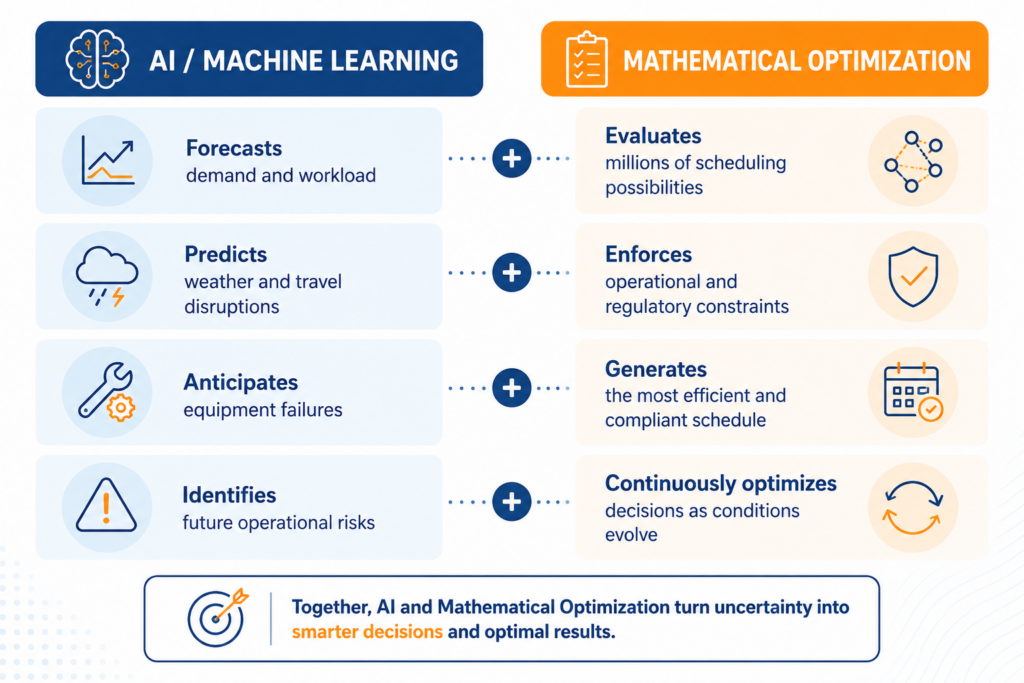
Using advanced techniques such as Constraint Programming (CP) and Mixed-Integer Programming (MIP), an optimization engine transforms those predictions into operational decisions. It evaluates millions of scheduling possibilities while simultaneously considering technician skills, travel times, SLAs, labor regulations, customer priorities, and business objectives.
Rather than producing a feasible schedule, it identifies the one that best achieves the organization’s operational goals.
By combining predictive AI with mathematical optimization, organizations move beyond reactive dispatching, continuously optimizing decisions as operational conditions evolve.
Continuous Optimization in Action
What does this look like in practice?
Imagine a field service organization managing hundreds of technicians and thousands of daily work orders. By mid-morning, an emergency work order is created, a customer cancels an appointment, and traffic disrupts multiple routes.
Rather than making isolated manual adjustments, an optimization engine re-evaluates the full schedule in seconds, balancing technician skills, travel times, SLAs, labor regulations, customer priorities, and business objectives simultaneously.
Instead of optimizing a single assignment, it optimizes the operation as a whole. The result is a schedule that remains optimized as operations evolve, minimizing disruption while improving productivity, maintaining compliance, and delivering a better customer experience.
A JLL company and one of the UK’s leading providers of mechanical, electrical, and fabric maintenance services, supports more than 1,600 clients across 60,000 locations.
Managing such a distributed workforce required balancing technician skills, travel times, and strict service commitments while continuously improving productivity.
Working closely with the client, DecisionBrain developed a tailored optimization solution that significantly increased the number of jobs completed per engineer each day.
Programme Director at JLL, explains:
“We were operating at 2.8 jobs per man per day and this optimization has taken us to 4 jobs per man per day. We can see that there is an opportunity to get to 5 jobs per man per day.”
Managing London’s public bike-sharing network requires coordinating a 24/7 operation across approximately 12,000 bicycles and 800 docking stations, balancing bike repositioning, maintenance, and constantly changing customer demand.
To address these challenges, DecisionBrain, together with IBM, developed a customized solution combining Machine Learning and Mathematical Optimization. Machine Learning forecasts customer demand using historical usage patterns, while Mathematical Optimization determines the best bike allocation, driver dispatching, and maintenance planning.
The implementation of the system delivered constant increases in daily bike hires, demonstrating improved service availability across the network.
These projects demonstrate that while every organization faces different operational constraints, the value of optimization is consistent. Across multiple field service deployments, DecisionBrain’s customized optimization solutions have helped organizations achieve:
- Up to 40% increase in technician productivity
- Up to 20% reduction in travel distances, lowering both transportation costs and CO₂ emissions
- Improved SLA compliance, particularly for time-critical response commitments
- 10 to 40% overall operational efficiency gains, while significantly reducing manual planning effort
Real-time scheduling is not simply about reacting faster to operational disruptions. It is about making better decisions, continuously.
Smarter Decisions. Better Results.
By combining predictive AI with advanced mathematical optimization, DecisionBrain’s enables organizations to make better decisions in real time, improving productivity, strengthening SLA compliance, and reducing operational costs.
See how DecisionBrain can build a scheduling solution tailored to your own operation, explore the full case studies or talk to our team.
At DecisionBrain, we deliver AI-driven decision-support solutions that empower organizations to achieve operational excellence by enhancing efficiency and competitiveness. Whether you’re facing simple challenges or complex problems, our modular planning and scheduling optimization solutions for manufacturing, supply chain, logistics, workforce, and maintenance are designed to meet your specific needs. Backed by over 400 person-years of expertise in machine learning, operations research, and mathematical optimization, we deliver tailored decision support systems where standard packaged applications fall short. Contact us to discover how we can support your business!
Read also