

Solution
Workforce
Industry
Healthcare and Life Sciences
Location
North America
Overview
What happens when academic scheduling becomes too complex to manage manually? For this dental school, it meant weeks of coordination, five full-time staff tied up each term, and growing risk to academic continuity.
A leading U.S. dental school was facing one of the most complex academic scheduling challenges in higher education. Multiple programs, clinical rotations, external partnerships, and strict calendar constraints made manual planning unsustainable and increasingly fragile.
The objective was to design a sustainable scheduling solution based on Constraint Programming (CP) that could fully automate planning while remaining flexible enough to evolve with curriculum changes and institutional strategy.

Challenges
The Reality Behind the Complexity
At a structural level, the problem involved three academic semesters, 126 students, and 13 non-interruptible clinical rotations with variable durations and capacity limits. Scheduling decisions had to respect half-day granularity, public holidays, and student-specific absences. The core feasibility challenge was to generate a single academic calendar in which every student could complete all required rotations without violating academic, capacity, or calendar constraints.
Beyond its formal structure, the scheduling process relied heavily on tacit, undocumented knowledge. The solution dramatically reduced manual planning effort and dependency on institutional expertise, freeing planning capacity previously tied up in weeks of coordination each term.
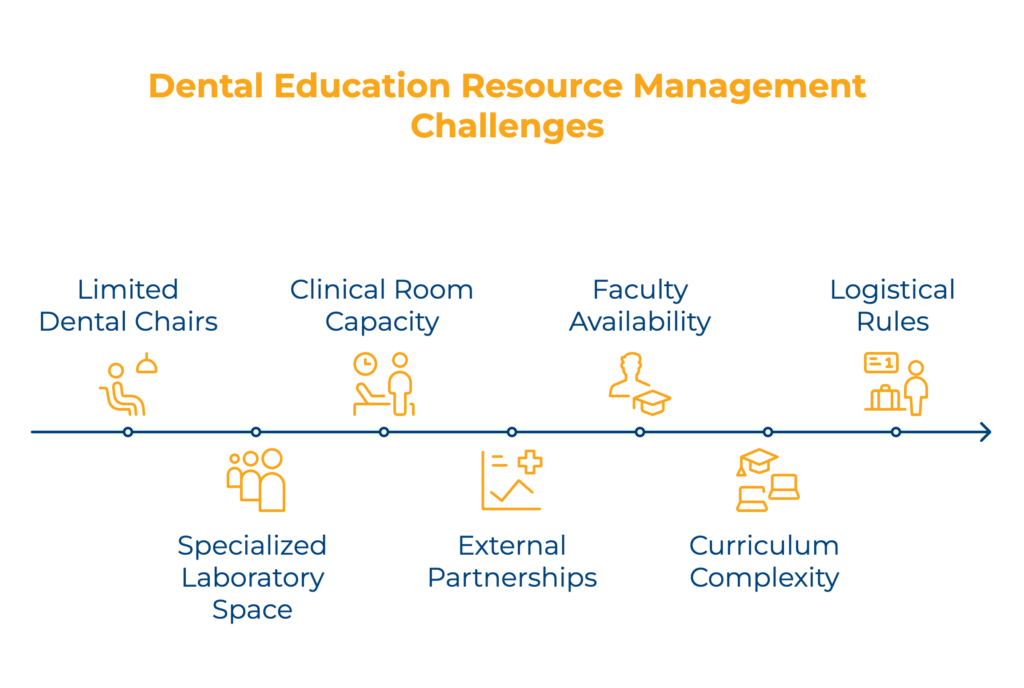
This complexity was amplified by real-world constraints. The school had to coordinate multiple academic programs, including dentistry, dental hygiene, and veteran-focused tracks, while operating under tight resource limitations:
- Physical Infrastructure: limited dental chairs, specialized laboratory space, and clinical room capacity;
- External Partnerships: semesterly changes in availability and requirements from external dental clinics;
- Faculty Availability: a national shortage of dental professionals intensified the need for optimized faculty resource allocation;
- Curriculum Complexity: coordination of non-standard and partial curricula for international students;
- Logistical Rules: student availability was also subject to personal and logistic constraints influencing availability and scheduling rules.
As a result, the tedious manual processes required by traditional tools and spreadsheets made an automated optimization approach not just beneficial, but unavoidable.
Solution
From Tacit Knowledge to a Scalable Constraint Programming Platform
DecisionBrain, in collaboration with IBM, designed a robust Constraint Programming (CP) model capable of formalizing dozens of academic, clinical, and logistical rules that had never been explicitly modeled before. The initial implementation focused on third- and fourth-year students, where scheduling complexity and operational impact were highest.
IBM’s CP optimization technology served as the core engine, enabling the model to reason explicitly over time, capacity, and availability constraints. To reduce technical barriers for administrators, DB Gene was introduced as the user interface layer, allowing non-technical users to confidently interact with sophisticated scheduling logic.
Measurable Outcomes and the Future of Academic Operations
The solution successfully generated complete and reliable schedules for the most complex student cohorts, eliminating weeks of manual coordination. On a representative scheduling instance:
- The model produces actionable schedules rapidly, enabling planners to explore alternative scenarios and make data-driven decisions within regular planning cycles;
- More refined solutions were obtained within under one minute;
- A dedicated heuristic produced near-optimal solutions almost instantaneously.
Beyond performance metrics, the impact was structural: planning effort was dramatically reduced, operational risk was mitigated through rule-based and reproducible schedules, and the institution gained a scalable foundation for future program expansion. What had once depended on a small group of experts became a shared, transparent, and resilient operational capability.
FAQ
Constraint Programming (CP) is well suited for complex scheduling because it can model and solve large numbers of interdependent constraints simultaneously. Many real-world scheduling problems involve time windows, capacity limits, resource availability, non-interruptible activities, and exception rules such as holidays or individual absences. Traditional tools struggle to manage these interactions consistently. CP allows all constraints to be expressed explicitly and solved together, ensuring feasible, reliable, and rule-compliant schedules.
Constraint Programming reduces operational risk by transforming tacit, experience-based decision-making into explicit, constraint-based models. Instead of relying on a small number of experts or undocumented practices, CP formalizes institutional rules, policies, and constraints into a reproducible optimization process. This makes planning transparent, auditable, and repeatable, significantly reducing dependency on individuals and improving continuity, resilience, and governance.
Constraint Programming models typically deliver results both in computational performance and operational efficiency. Feasible solutions can often be generated in seconds, with higher-quality solutions obtained through further optimization. In practice, planning cycles that previously took days or weeks can be reduced to automated runs, while maintaining high compliance with complex constraints and achieving near-optimal solutions within acceptable computation times.
Yes. Constraint Programming models are inherently modular and scalable. Once the core structure is in place, new constraints, resources, time horizons, or decision variables can be added without redesigning the entire solution. This makes CP well suited for expanding existing scheduling systems to new programs, larger populations, or more complex operational environments.
Constraint Programming is widely applicable across domains that require complex planning and scheduling under specific and concurrent constraints. Typical applications include:
- Workforce and shift scheduling
- Healthcare operations
- Clinical and operating room planning
- Transportation and logistics
- Manufacturing and production planning
- Energy and infrastructure scheduling
- Large-scale project planning.
Its flexibility makes it a powerful optimization approach wherever rules, resources, and time must be coordinated consistently.
Other Customer Stories