Blog
How to Choose Demand Planning Software That Supports Your Entire S&OP Process
Many companies invest in demand planning software expecting better forecast accuracy, smoother operations, and more aligned S&OP cycles.
But in reality, most planning teams still face the same operational problems. Companies are no longer looking for forecasting tools alone. They need planning solutions that connect demand, supply, inventory, and operational decisions across the full S&OP process.
That is exactly where traditional planning systems often fall short, and where DecisionBrain helps companies operate differently.
Forecasting Alone Does Not Solve S&OP Complexity
A forecast only creates value if the organization can execute against it operationally.
Consider a consumer goods manufacturer preparing for a seasonal demand increase, yet still struggling to deliver products because suppliers lack capacity, production schedules are constrained, or inventory is positioned incorrectly across the network.
The result is familiar:
- stockouts in critical markets;
- excess inventory elsewhere;
- service-level issues;
- constant firefighting during S&OP cycles.
The problem is not forecasting itself. The problem is the disconnect between forecasting and operational execution.
That is why modern S&OP requires more than reporting dashboards and statistical models. Many demand planning systems generate forecasts successfully but struggle to connect those forecasts to supply constraints, operational trade-offs, and execution decisions.
As supply chains become more volatile, that gap becomes increasingly expensive.
What Companies Should Look for in Demand Planning Software
- Scenario Planning That Reflects Operational Reality
Supply chains rarely operate under stable conditions. Demand changes quickly. Suppliers become unreliable. Transportation constraints appear unexpectedly.
Planning teams need to evaluate scenarios fast, before disruptions become operational problems.
Imagine a packaging manufacturer dealing with volatile demand and machine constraints across multiple plants. Leadership needs to understand:
- which production lines should be prioritized;
- how inventory targets will be affected;
- whether supply shortages will impact service levels;
- what trade-offs exist between cost and responsiveness.
Without scenario modeling, these decisions often become manual and reactive.
This is where optimization, AI-driven planning, and operational decision support become increasingly important for modern S&OP processes.
- Integration Between Demand and Supply Planning
One of the biggest weaknesses in many S&OP processes is the disconnect between demand planning and production feasibility.
A forecast may look achievable on paper while remaining operationally impossible once production, inventory, and supply constraints are considered.
This becomes especially difficult in industries where production outputs, inventory flows, and customer demand are tightly interconnected.
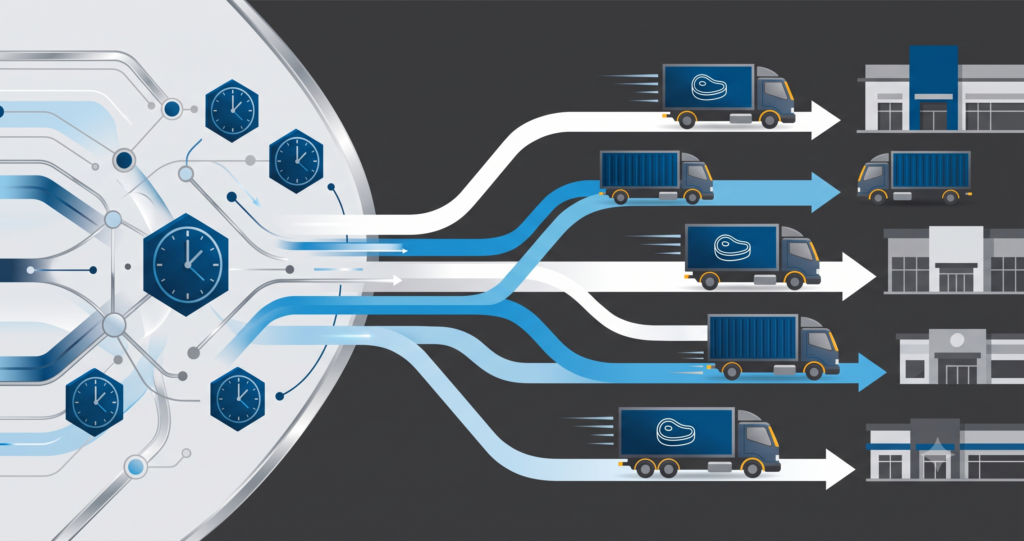
DecisionBrain’s approach integrates demand forecasting with production and inventory planning in a single environment, so constraints surface at the demand review stage, not after production commitments are made.
For example, Cooperl, a leading European pork producer, was managing fresh and frozen products in separate systems while relying heavily on Excel-based planning. The company struggled with overstocking, demand satisfaction gaps on high-value cuts, and operational inefficiencies caused by unnecessary freezing and downgrading.
To improve planning alignment, DecisionBrain implemented an integrated optimization system capable of balancing demand pull with incoming supply constraints while continuously re-optimizing production plans based on actual operational results.
As supply chains become more volatile, companies increasingly need planning environments that connect demand signals directly to operational realities across production, inventory, and supply planning.
- Faster Decision-Making Under Uncertainty
Many planning teams still spend significant time consolidating spreadsheets and reconciling data across departments. By the time decisions are finalized, conditions have already changed.
Modern planning environments require much faster decision cycles.
For a leading global apparel manufacturer managing thousands of customer-specific styles across 11 factories, manual planning involved more than ten planners and still produced slow, error-prone results with low on-time delivery. DecisionBrain’s production planning solution automated the planning process, reduced late orders and cycle times, and increased throughput, not by replacing planners, but by giving them a tool that made complex trade-offs visible and manageable.
This is driving increased interest in technologies that combine analytics, optimization, and scenario analysis to help planners evaluate alternatives more quickly and make more executable operational decisions.
Moving Beyond Traditional Planning Platforms
The platforms most companies evaluated five or ten years ago were designed to answer one question: what will demand look like? But the questions that actually determine whether your S&OP creates value are different:
- Can we execute this forecast given our current capacity?
- What happens to service levels if Supplier A is delayed by two weeks?
- Which trade-off, lower cost or higher service, is right for this SKU family in this quarter?
- How do we replan fast when the situation changes mid-cycle?
These are not forecasting questions. They are operational decision-making questions. And they require a platform built around optimization, scenario analysis, and integration across the full planning stack, not just statistical modeling on top of historical demand data.
DecisionBrain’s supply chain planning solutions are built around that reality. Our tactical production planning and strategic capacity planning capabilities are designed to connect directly with demand signals, so the outputs of your demand review feed directly into feasible, optimized operational plans, not just targets on a slide.
Choosing the Right Demand Planning and S&OP Platform
If you’re evaluating demand planning and forecasting software for a full S&OP process, the key question isn’t simply “how accurate is the forecast?”
It’s whether the platform can connect demand review, supply planning, scenario analysis, and operational execution in a way that makes the entire planning process faster, more aligned, and genuinely executable.
DecisionBrain works with global industrial organizations to build planning solutions designed for real operational complexity.
If your current S&OP tools are holding you back, speak with one of our supply chain experts or explore our S&OP and Supply Chain Planning solutions.
At DecisionBrain, we deliver AI-driven decision-support solutions that empower organizations to achieve operational excellence by enhancing efficiency and competitiveness. Whether you’re facing simple challenges or complex problems, our modular planning and scheduling optimization solutions for manufacturing, supply chain, logistics, workforce, and maintenance are designed to meet your specific needs. Backed by over 400 person-years of expertise in machine learning, operations research, and mathematical optimization, we deliver tailored decision support systems where standard packaged applications fall short. Contact us to discover how we can support your business!
Lire aussi